
|
 |
Research Highlight
A New Promising Thermoelectric Material with Cubic and Complex Crystal Structure
Cubic materials with complex crystal structures are promising for thermoelectric conversion. The multivalley electronic structure stemming from the cubic symmetry increases Seebeck coefficient S keeping low electrical resistivity ρ, and the complex crystal structure reduces the phonon contribution of thermal conductivity κlat. When atoms are enclosed in highly symmetric and oversized cages in their crystal structures, the rattling effect can further suppress κlat while maintaining a high electrical conductivity. In fact, there are several material families with cubic and complex crystal structures that exhibit high thermoelectric performance, such as filled skutterudite and clathrate.
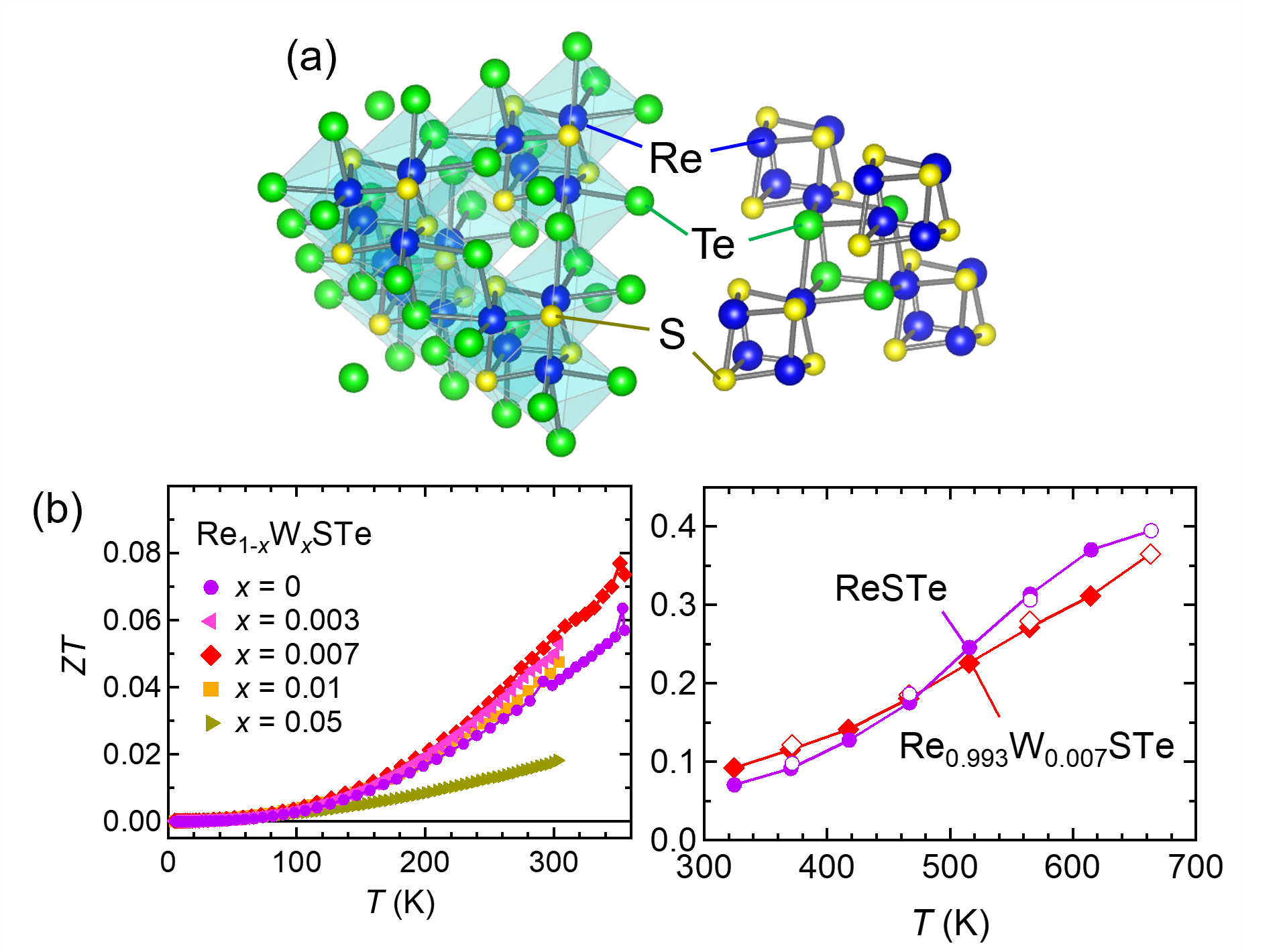
We report the thermoelectric properties of ReSTe with cubic and complex crystal structure. ReSTe was first synthesized by Fedorov et al. in powder form and was reported to crystallize in a cubic MoSBr type, as shown in Fig. 1(a) [1]. Their transport properties have not been reported, because the only small single crystals have been synthesized thus far. We succeeded in synthesizing undoped, W-doped, and Sb-doped ReSTe sintered samples and investigated their thermoelectric properties [2].
|
Figure 1. (a) Crystal structure of ReSTe. (b) Temperature dependences of the dimensionless figure of merit ZT. (a) ZT of the sintered Re1−xWxSTe samples below 350 K. (b) ZT of the sintered ReSTe and Re0.993W0.007STe samples above room temperature.
|
The undoped ReSTe exhibited a positive S increasing with increasing temperature with a concave downward curve. The value of S was the largest among all the samples, exceeding 260 μV K−1 at 300 K, which is high enough to be a thermoelectric material. The ρ of undoped ReSTe exhibits a semiconducting temper-ature dependence, with ρ exponentially increasing with decreasing temperature. The value of ρ = 30 mΩ cm at 300 K is one order of magnitude higher than that of practical materials. With increasing W content x, both S and ρ systematically decrease, and the temper-ature dependence of ρ becomes weaker.
As shown in the left panel of Fig. 1(b), the dimensionless figure of merit ZT evaluated using these physical properties (ZT = S2T/ρκ) increased with increasing temperature for all the samples. Over the entire temperature range below room temperature, the lightly W-doped samples showed a large ZT; the x = 0.007 sample exhibited the largest ZT = 0.055 at 300 K, whereas the undoped sample exhibited ZT = 0.04 at the same temperature. As shown in the right panel of Fig. 1(b), the ZT values of the undoped and x = 0.007 samples increased significantly at higher temperature. They exhibit ZT = 0.39 and 0.36, respectively, at the highest measured temperature of 660 K, indicating they are promising p-type thermoelectric materials. This high performance is attributed to large power factor P = S2/ρ owing to the degenerate semiconducting state realized by the strong spin–orbit coupling and low lattice thermal conductivity of the sintered samples. Furthermore, the electronic band dispersion at the bottom of the conduction band of ReSTe is almost flat owing to the large band splitting in the valence band caused by the strong spin–orbit coupling. These results strongly suggest that a high thermoelectric performance far beyond that of the p-type can be realized in n-type samples, indicating the great potential of tellurides with cubic and complex crystal structures as thermoelectric materials.
[1] V. E. Fedorov, Y. V. Mironov, V. P. Fedin, and Y. I. Mironov. J. Struct. Chem. 35, 146 (1994).
[2] H. Matsumoto, H. Isomura, K. Kojima, R. Okuma, H. Ohshima, C.-H. Lee, Y. Yamakawa, and Y. Okamoto, Appl. Phys. Lett. 126, 243903 (2025).